The Internet of Things (IoT): Connecting the World Around Us
The Internet of Things (IoT) refers to a network of physical devices that are connected to the internet and can collect, share, and exchange data. These devices include everyday objects such as smartphones, smart home appliances, wearable devices, industrial machines, and even vehicles. IoT is transforming how people live, work, and interact with technology.
How IoT Works
IoT systems consist of several key components: devices (or “things”), sensors, connectivity, data processing, and user interfaces. Sensors collect data from the environment, such as temperature, motion, or location. This data is then transmitted through the internet to a central system where it is processed and analyzed. Finally, the system provides useful insights or triggers actions, often without human intervention.
For example, a smart thermostat can detect room temperature and automatically adjust the heating or cooling system to maintain comfort while saving energy.
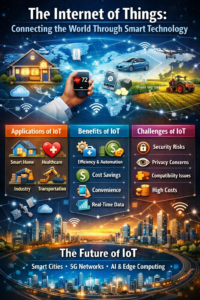
Applications of IoT
IoT has a wide range of applications across different sectors:
- Smart Homes: Devices like smart lights, security cameras, and voice assistants make homes more efficient and secure.
- Healthcare: Wearable devices can monitor heart rate, sleep patterns, and physical activity, helping doctors provide better care.
- Agriculture: Farmers use IoT sensors to monitor soil conditions, weather, and crop health, improving productivity.
- Transportation: Connected vehicles and traffic systems help reduce congestion and improve safety.
- Industry (IIoT): In manufacturing, IoT helps monitor equipment, predict maintenance needs, and optimize production.
Benefits of IoT
The Internet of Things offers many advantages:
- Efficiency: Automation reduces manual work and improves productivity.
- Cost Savings: Predictive maintenance and resource optimization lower operational costs.
- Convenience: Smart devices make daily tasks easier and more comfortable.
- Better Decision-Making: Real-time data allows businesses and individuals to make informed decisions.
Challenges and Risks
Despite its many advantages, IoT also presents several challenges and risks:
- Security Issues: Connected devices can be vulnerable to hacking and cyberattacks if not properly secured. Weak passwords and outdated software increase these risks.
- Privacy Concerns: IoT devices collect large amounts of personal data, which may be misused or accessed without consent.
- Compatibility Problems: Different devices and platforms may not work well together due to lack of standardization.
- High Implementation Costs: Setting up IoT systems can require significant investment in hardware, software, and infrastructure.
The Future of IoT
The future of IoT looks promising as technology continues to evolve. With the growth of 5G networks, IoT devices will become faster, more reliable, and capable of handling larger amounts of data. Artificial Intelligence (AI) will also enhance IoT systems by enabling smarter decision-making and automation.
In the coming years, IoT is expected to play a key role in the development of smart cities, where infrastructure such as transportation, energy, and public services are interconnected to improve quality of life. Additionally, advancements in edge computing will allow data to be processed closer to the source, reducing latency and improving efficiency.
Conclusion
The Internet of Things is revolutionizing the way we interact with the world by connecting devices and enabling them to communicate intelligently. While there are challenges to address, the benefits of IoT in improving efficiency, convenience, and innovation are undeniable. As technology continues to advance, IoT will become an even more integral part of our daily lives, shaping the future of industries and society as a whole.